Difference Between Hajj and Umrah
Hajj and Umrah are two significant religious pilgrimages in Islam that are often spoken of together, but they are quite distinct from each other in terms of their rituals, requirements, and significance. Put simply, Umrah is a short pilgrimage that you can do at any time, whereas Hajj takes longer, involves more rituals, and can only be performed at a specific time of year.
What is Umrah?
Umrah is a simpler version of a pilgrimage to the holy city of Makkah, and is sometimes known as the ‘minor pilgrimage’ or the ‘lesser pilgrimage’. Umrah comprises certain rituals that can be performed at any time of the year and only takes just a few hours to complete. Although it’s recommended, it is not a compulsory pilgrimage, nor is it one of the five Pillars of the Islamic religion. It’s still an incredibly sacred journey that millions of Muslims undertake annually to come closer to Allah (SWT).How is Umrah Performed?
Once you have the correct attire and have entered the sacred state of Ihram, the key rituals to perform Umrah are Tawaf and Sa’i.
What is Hajj? How is Hajj Different from Umrah?
One of the most significant distinctions between Hajj and Umrah is that Hajj is the fifth and final Pillar of Islam, making it an essential act of worship. It is obligatory for all Muslims to perform at least once in their lifetime, provided they are physically, mentally, and financially able to do so.In contrast, Umrah is not compulsory and can typically be completed within a single day, whereas Hajj takes around five to six days to fulfill, requiring a greater commitment of time and effort. Another key difference lies in timing. Umrah may be performed at any time of the year, while Hajj is restricted to specific days during the Islamic month of Dhul Hijjah. Despite these differences—particularly in obligation and duration—both Hajj and Umrah involve similar rituals and hold great spiritual significance. Each offers immense rewards, blessings, and spiritual growth, as both pilgrimages were practiced by Prophet Muhammad (peace be upon him).
How to Perform Hajj
The sacred journey of Hajj begins in a way similar to Umrah, with pilgrims traveling to the Ka’aba to perform Tawaf, followed by Sa’i—the act of walking back and forth between Safa and Marwa. However, Hajj includes several additional rites that distinguish it from Umrah.
After completing Sa’i, pilgrims proceed to Mina, where they spend the night before continuing to Mount Arafat on the Day of Arafah—the ninth day of Dhul Hijjah and the second day of Hajj. This day is considered the most sacred of the year. Pilgrims gather at Jabal al-Rahmah, believed to be the place where Prophet Muhammad (peace be upon him) delivered his final sermon, and engage in Wuquf—standing in devotion and supplication to Allah until sunset.
Following their time at Arafat, pilgrims travel to Muzdalifah, where they offer prayers and spend the night. The next day, they return to Mina to perform Rami al-Jamarat, the ritual of throwing stones at the pillars symbolizing the devil. On this same day, the festival of Eid al-Adha begins, lasting four days. During this time, animals are sacrificed in remembrance of Prophet Ibrahim’s unwavering devotion to Allah. This act, known as Qurbani or Udhiya, is a key ritual of Hajj, and the meat is distributed among those in need.
Completing Hajj is physically demanding and requires great endurance, but it holds immense spiritual significance. By fulfilling these rites sincerely, Muslims seek Allah’s mercy and forgiveness for their past sins. Although both Umrah and Hajj are pilgrimages to Makkah involving similar practices, they differ in importance and scope. Umrah is a shorter, non-obligatory journey that can be performed at any time of the year. In contrast, Hajj is a mandatory act of worship with more extensive rituals, which every capable Muslim is required to perform at least once in their lifetime.
 |
Differences between Hajj and Umrah
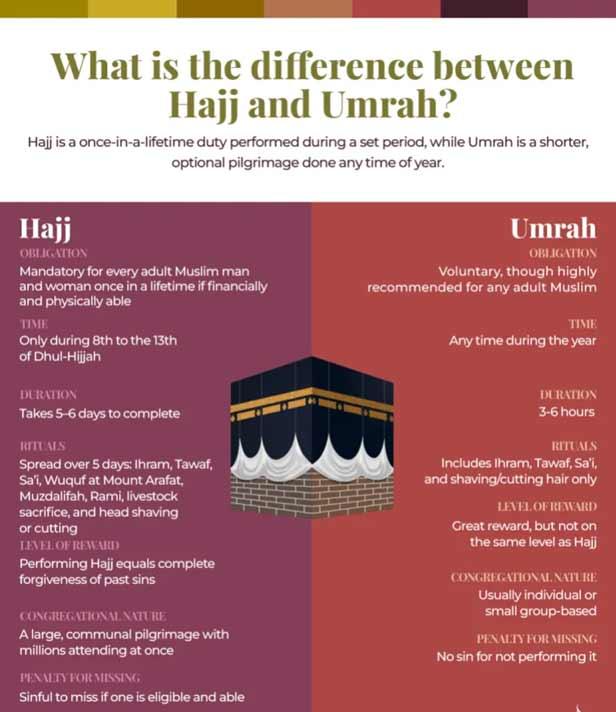
While both Hajj and Umrah involve visiting the sacred sites in Makkah and share some common rituals, there are several important differences between the two:
Obligation
Umrah is a voluntary act of worship and is not obligatory (fardh). In contrast, Hajj is one of the five pillars of Islam and is mandatory for every Muslim who is physically, mentally, and financially capable of undertaking the journey at least once in their lifetime.
Time & Duration
Umrah can be performed at any time of the year, except during the specific days of Hajj. It is relatively short and can usually be completed within a few hours (around 3–6 hours).
There are two types of Umrah:
Umrah al-Mufradah: Performed independently at any time of the year (excluding Hajj days).
Umrah al-Tamattu: Performed alongside Hajj during the month of Dhul Hijjah, before the Hajj rituals begin.
Hajj, on the other hand, is performed only during specific dates—from the 8th to the 12th or 13th of Dhul Hijjah—and takes several days to complete, making it a longer and more structured pilgrimage.
Rituals
The rituals of Umrah include entering the state of Ihram, crossing the Miqat, performing Tawaf (circling the Kaaba), completing Sa’i (walking between Safa and Marwa), and finishing with Halq (shaving the head) or Taqsir (trimming the hair).
Hajj includes all the rituals of Umrah but also involves additional acts. These include staying in Mina, standing at Arafat (Wuquf), spending the night in Muzdalifah, performing Rami al-Jamarat (stoning the pillars symbolizing Shaytaan), and offering Qurbani (sacrifice).
In summary, while Umrah is a shorter, non-obligatory pilgrimage that can be performed almost any time of the year, Hajj is a compulsory, more extensive journey with additional rituals carried out during specific dates.
Similarities Between Hajj and Umrah
Hajj and Umrah are both sacred pilgrimages undertaken by Muslims to the holy city of Makkah in the Hejaz region of present-day Saudi Arabia. Despite their differences, they share several important similarities:
1. Spiritual Purpose
Both Hajj and Umrah are acts of worship performed to seek the pleasure of Allah. They offer immense spiritual rewards and, when accepted, can lead to the purification of the heart and soul. These journeys help strengthen a المسلم’s connection with Allah and provide a deeply meaningful spiritual experience.
2. State of Ihram
For both pilgrimages, Muslims must enter the state of Ihram—a condition of spiritual purity and devotion—before crossing the designated boundary (Miqat). This state involves specific intentions, dress, and restrictions.
3. Shared Rituals
Hajj and Umrah include several common rites, such as: Tawaf: Circling the Kaaba seven times in worship. Sa’i: Walking between the hills of Safa and Marwa. Halq or Taqsir: Shaving the head or trimming the hair to complete the pilgrimage.
4. Following the Sunnah
Both Hajj and Umrah were performed by Prophet Muhammad (peace be upon him), making them part of his Sunnah. Observing these pilgrimages allows Muslims to follow in his footsteps and fulfill an important aspect of Islamic tradition. In essence, while Hajj and Umrah differ in obligation and scale, they are united in their purpose, rituals, and spiritual significance.
Is Hajj harder than Umrah?
Yes, Hajj is generally more physically and mentally demanding than Umrah. While both are spiritually rewarding, Hajj involves a more extensive set of rituals and greater endurance.
Hajj includes additional rites such as traveling to and staying in Mina, standing in devotion at Arafat, spending the night in Muzdalifah, and performing Rami (stoning the pillars symbolizing Shaytaan). These movements between locations, combined with long periods of عبادah (worship), can be physically tiring.
Accommodation during Hajj can also be challenging. In Mina, pilgrims stay in shared tents, often with limited space, while in Muzdalifah, they spend the night outdoors under the open sky. These conditions may feel uncomfortable compared to everyday living.
Another factor is the sheer number of people. Millions of pilgrims gather during Hajj season, making Makkah and surrounding areas extremely crowded. This can lead to congestion and require patience and resilience. In contrast, Umrah is shorter, simpler, and can be performed at less crowded times of the year, making it generally less demanding overall.
Can Umrah replace Hajj?
No, Umrah cannot replace Hajj. Although Umrah is a highly rewarding act of worship, it is not obligatory. Hajj, on the other hand, is one of the five pillars of Islam and is mandatory for every Muslim who is physically, mentally, and financially able to perform it at least once in their lifetime. Because of this, performing Umrah does not fulfill the obligation of Hajj. Hajj holds a unique and essential status in Islam, and it must be completed separately by those who are capable.
Is there a limit on Umrah?
No, there is no set limit on how many times a person can perform Umrah. A Muslim may undertake Umrah as often as they are able throughout their lifetime. While temporary restrictions were introduced during the COVID-19 pandemic, these have since been lifted, and pilgrims are once again free to perform Umrah without such limits.
From an Islamic perspective, there is no fixed number of Umrahs one must or should perform. However, it is worth noting that Prophet Muhammad (peace be upon him) performed Umrah four times in his lifetime. For those who wish to follow his Sunnah, this can serve as a meaningful example though it is not a requirement.
Step-by-Step Guide to Perform Hajj
Step 1 – Enter Ihram
Wear Ihram clothing and make intention for Hajj.
Step 2 – Tawaf
Circle the Kaaba seven times in worship.
Step 3 – Sa’i
Walk between Safa and Marwah hills.
Step 4 – Day of Arafah
Stand in Arafah and make dua — the most important part of Hajj.
Step 5 – Muzdalifah & Mina
Collect pebbles and perform rituals including stoning the pillars (Rami).
Step 6 – Qurbani & Hair Cutting
Sacrifice an animal and trim or shave hair.
Step 7 – Final Tawaf
Perform Tawaf again before leaving Makkah.
Benefits of Performing Hajj & Umrah
* Removes past sins
* Strengthens faith
* Brings spiritual peace
* Builds unity among Muslims
Tips for First-Time Pilgrims
* Learn rituals beforehand
* Stay patient and calm
* Make lots of dua
* Follow guidance of scholars
FAQs
Q1: What is the difference between Hajj and Umrah?
Hajj is and performed on specific dates, while Umrah is optional and can be done anytime.
Q2: How long does Hajj take?
Hajj usually takes 5–6 days.
Q3: How long does Umrah take?
Umrah can be completed in a few hours.
Q4: Is Hajj compulsory for all Muslims?
It is compulsory only for those who are physically and financially able.
Q5: What are the main rituals of Hajj?
Ihram, Tawaf, Sa’i, Arafah, Mina, and Qurbani.
Q6: Can women perform Hajj and Umrah?
Yes, women can perform both with proper guidelines.
Q7: What should I recite during Hajj and Umrah?
Talbiyah, duas, and Quran recitation.